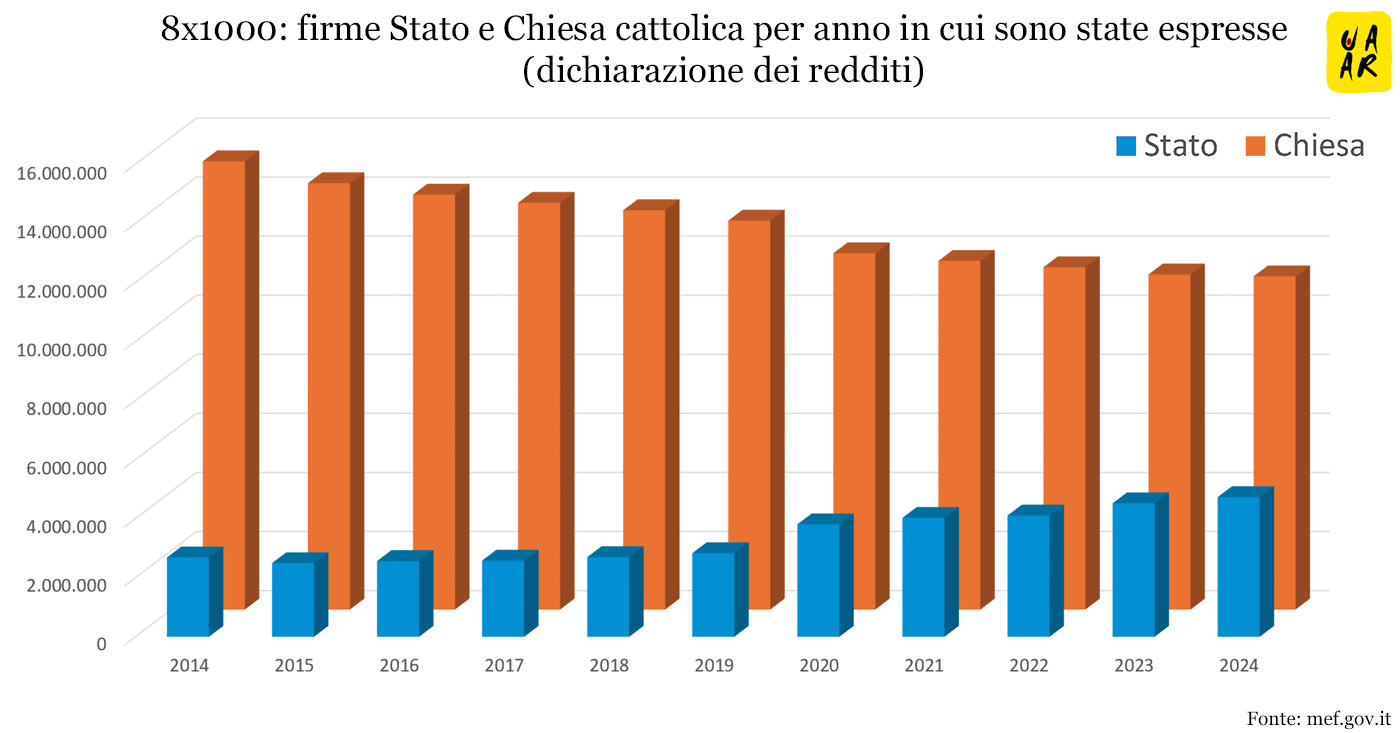
Another billion for the Church. But more and more taxpayers are choosing the State and fewer and fewer are choosing the Catholic Church. The intervention category promoted by the Meloni government for drug and other addiction recoveries has failed.
This year, the Ministry of Economy and Finance has also published data on the 8×1000 amounts paid in 2025, referring to the 2021 tax year, and provisional data on taxpayer choices made in 2024, which will be used in the 2027 distribution. The slow but inexorable decline in 8×1000 preferences for the Catholic Church is immediately apparent. In the 2027 distribution, the number of taxpayers choosing the 8×1000 falls to 26.50%, a loss of over 1.45% compared to the 2025 distribution, or 317,000 taxpayers. And it is thanks to the deceptive mechanism of the distribution of the unexpressed that the 26.50% of expressed choices translates into 66.16% of appropriation of public resources by the bishops.
According to the 2025 distribution (data relating to 2021 income, declarations filed in 2022), the Church receives approximately €430 million from expressed choices, while approximately €624 million derives from unexpressed choices. The total subtracted from general taxation and paid to the Italian Episcopal Conference is, in fact, €1.53 billion. But the increase in public resources allocated to the Church is certainly not the result of taxpayer preferences, which continue to decline. The increase (from €990 million last year to €1.53 billion for the 2025 distribution) is justified by the increase in personal income tax revenue recorded in 2021 compared to 2020, due to the recovery from the pandemic crisis.
Looking at the graph, the situation is very clear: 10 years ago, the Church had over 15 million signatures in its favor, while in 2025, it has just over 11.5 million. And while the Church declines, the State grows the most: in 2014, 2.5 million taxpayers signed for the State, while in 2025, the figure is 4.11 million. The new data also shows that in the 2027 distribution, the State will be able to count on 618,000 more signatures, going from 4.11 million to 4.728 million.
Among the options for the State, the most popular option was “School Building”, with 1.22 million taxpayers ticking the box. 402,000 taxpayers signed for “World Hunger”, 501,000 for “Natural Disaster”, 197,000 for “Refugee Assistance”, and 388,000 for “Cultural Heritage”. The data reveal something completely new: the failure of the intervention category promoted by the Meloni government, “Recovery from drug addiction and other pathological dependencies,” which accounted for 0.16% of the options. Only 66,000 taxpayers signed for what Minister Antonio Tajani called a way to get the money to the Church: “A portion of the funds allocated to the State,” Tajani stated, “goes to drug rehabilitation centers, many of which are run by Church organizations, so there is no harm to the Church.” The most secular types of expenditure, “School Building” and “Natural Disaster”, have over 2.3 million signatures.
An interesting analysis of the data at the regional level shows Emilia-Romagna remaining in the lead for “secular” choices: 17.21% of taxpayers sign for the State, 24.25% for the Church. Tuscany remains in second place (13.26% State, 22.36% Church). Surprisingly, the Autonomous Province of Bolzano is now in third place (12.49% State, 22.92% Church), followed by Liguria.
“Cardinal Zuppi’s concern,” says Roberto Grendene, Secretary of the UAAR, “is understandable: more and more taxpayers are choosing the State and fewer and fewer the Church. The head of the bishops simply raised his voice, and the government eliminated the advert for the 8×1000 tax contribution to the state, which had been broadcast on RAI networks for a few days. The government should instead eliminate the deceptive 8×1000 mechanism, and immediately eliminate the subterfuge of distribution resulting from unexpressed decisions. Without it, 624 million would have remained in general taxation, and the Church would have collected only 430 million, not 1.53 billion.
Press release