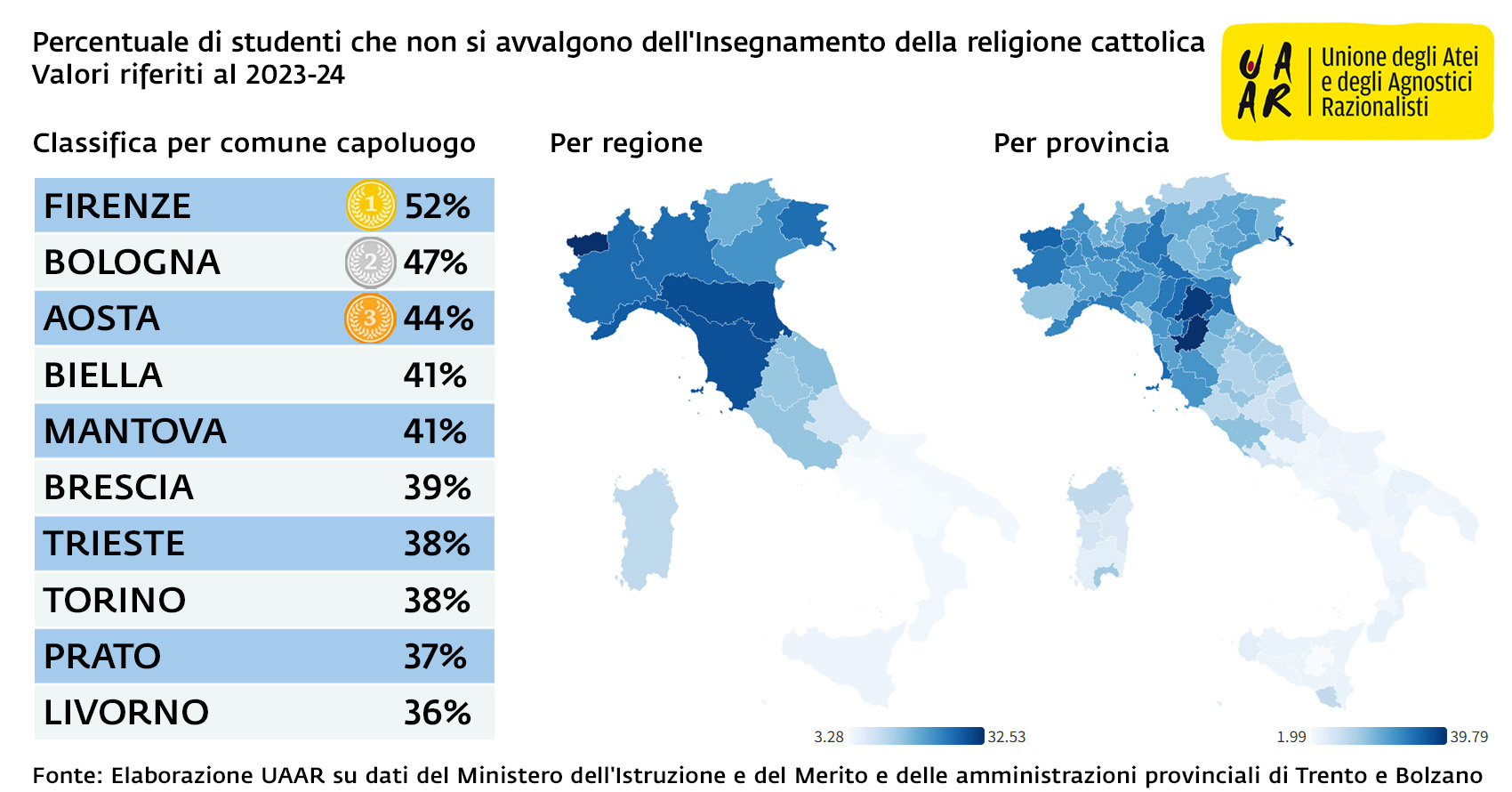
The UAAR has once again knocked on the door of the Ministry of Education and Merit and the autonomous provinces of Trento and Bolzano with a general civic access, recovering data on attendance at Catholic religious education (IRC) in Italian state schools. Students who chose not to attend religious education, which are still archaically and disrespectfully called “exempted,” reached a record number of 1,164,000 (+68,000), rising from an average of 15.5% in 2022/23 to 16.62% in 2023/24.
Analyzing the provincial capitals, Florence (51.51%) stands out as the secular capital. Following are the municipalities of Bologna (47.29%), Aosta (43.58%), Biella (40.62%), Mantua (40.54%), Brescia (38.6%), Trieste (37.94%), and Turin (37.67%). Taranto, Benevento, and Barletta are at the bottom of the list, with percentages under 3%. Considering the entire provincial territory, Florence (39.79%) and Bologna (38.15%) remain in the lead, while Naples stands out in third-last place with 2.93%, followed only by Barletta-Andria-Trani (2.13%) and Enna (1.99%). At the regional level, Valle d’Aosta leads with 32.53%.
Emilia-Romagna follows in second place with 29.33%, and Tuscany in third place with 29.01%. Northern Italy maintains rates around 25% (Liguria, Piedmont, Lombardy, and Friuli Venezia Giulia), falling to 21.29% in Veneto and 17.84% in Trentino-Alto Adige. In Central Italy, Marche, Lazio, and Umbria remain at around 15%, while moving south, Sardinia and Abruzzo hover around 10%, and all other southern regions remain below 5% (Sicily, Calabria, and Puglia around 4%, Basilicata and Campania around 3%).
It should be noted that, for the sake of prudence, data from 2,619 schools were excluded from the counts, where temporal inconsistencies or extremely low numbers of students using the service raised concerns about the accuracy of the data reported to the Ministry by the schools.
In the top five schools, the Olivetti Vocational and Technical School in Ivrea leads the way, ranking first and second with 90.7% and 87.88% of students not taking religious instruction. In many cases, the number of adult students at technical and vocational schools who attend evening classes influences the school’s overall percentage. The Sassetti-Peruzzi Technical School in Florence follows in third place with 86.78% not taking religious instruction, the Nazario Sauro Primary School in Monfalcone (GO) in fourth place with 86.45%, and the Carrara Vocational School in Novellara (RE) in fifth place with 86.29%.
The “Leon Battista Alberti” high school in Florence leads the way among middle schools (84.65%), while the “Rodari” high school in Torre Pellice (Turin) leads among middle schools with 83.70%, while the “San Giacomo” high school in Brescia leads among preschools with 83.58% of children aged 3-5. The national data by school type shows vocational schools in first place with 27.83%, followed by technical institutes with 25.31%, and high schools in third place with 18.48%. Middle schools, primary schools, and preschools rank between 15.77% and 12.4%.
“For the umpteenth time,” states Roberto Grendene, national secretary of Uaar, “the Union of Rationalist Atheists and Agnostics is filling ministerial gaps and making public information that is incredibly missing from the Unified School Data Portal.” Minister Valditara seems a bit too focused on prioritizing religious education, with sham competitions to hire tenured teachers chosen by the bishop and with the recent idea of having six-year-olds study the Bible in an identity-based way. Instead, he should protect the rights of the growing number of families demanding a secular school and begin to consider a national education system free of the burden of Catholic religious instruction.
UAAR is participating in the #datiBeneComune (“#DataAreCommonGood”) campaign and is making the data on non-attendance at IRC available to everyone at https://uaar.it/dati-no-irc. This page includes graphical analyses (by region, province, and school type), lists by province, and all schools in the same province (downloadable in CSV format for further processing), and detailed information on each individual school with historical data for the last six years.
Press release